
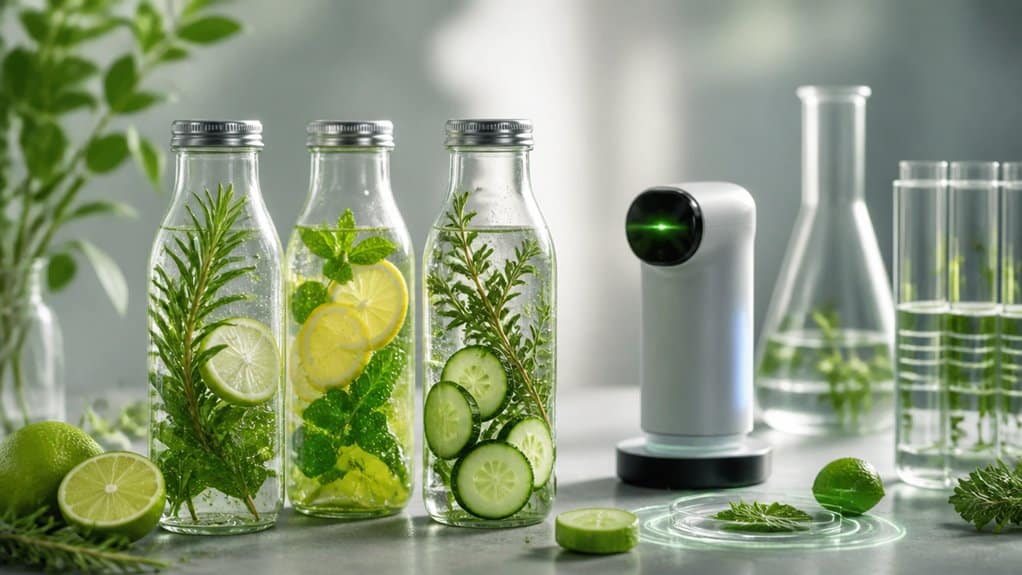
Clean-label beverages use familiar, clearly named ingredients, but no single legal definition governs the term. You can use AI to screen ingredient interactions and optimize formulations, while precision fermentation and advanced extraction produce targeted flavors, proteins, and other components. Traceability verifies ingredient origins and supports sourcing claims. To protect safety, taste, and shelf life, you’ll need suitable pH control, oxygen barriers, validated processing, and stability testing. The following sections explain how these technologies work—and where scale-up gets difficult.
What Does “Clean Label” Mean for Beverages?
In beverages, “clean label” generally describes products whose ingredient lists emphasize familiar, clearly named components and avoid certain additives, such as artificial colors or flavors. When you assess a drink, look beyond front-of-pack claims: the ingredient list reveals its sweeteners, preservatives, colors, and flavor sources.
Clean label has no single legal definition, so companies may use the term differently; check applicable regulations and the product’s actual composition.
“Clean label” has no single legal definition, so check applicable regulations and review the product’s actual ingredients.
Natural sourcing can support a simpler ingredient profile, but “natural” doesn’t automatically mean safer, healthier, or minimally processed. You should evaluate ingredients by their function, origin, and evidence, rather than relying on broad marketing language.
Clear labeling helps you compare products and understand what you’re consuming. When brands name ingredients plainly and substantiate claims, they can strengthen Consumer trust without implying that every additive is harmful or every familiar ingredient is beneficial.
How Can AI Improve Clean-Label Formulation?
AI models can predict how clean-label ingredients will affect stability, texture, flavor, and shelf life by analyzing formulation and test data.
You can use these predictions to compare ingredient choices before running costly trials.
Optimization algorithms can then help balance natural ingredients to meet performance targets while reducing reliance on synthetic additives.
Predicting Ingredient Performance
How can you predict whether a clean-label ingredient will perform in a new formulation before running costly trials? AI models can estimate ingredient behavior by learning from structured data on composition, pH, processing, storage, and sensory results.
You can use these predictions to screen candidates for solubility, stability, viscosity, and interactions with other components. Models trained on relevant beverage data can flag likely risks, such as sedimentation or flavor changes, while showing uncertainty where evidence is limited. That helps you prioritize experiments rather than treat predictions as proof.
For Flavor innovation and sensory enhancement, machine learning can relate ingredient profiles to panel scores and consumer responses, guiding targeted tests for taste, aroma, and mouthfeel. You’ll still need bench validation: real matrices and processing conditions can expose effects absent from training data.
Optimizing Natural Formulations
Once you’ve identified promising ingredients, AI can help optimize their proportions and processing conditions to meet clean-label targets without sacrificing product quality. It can model how pH, temperature, mixing, and storage affect flavor, color, texture, and stability, then compare formulation options against your specifications.
By analyzing experimental data, machine-learning models can identify ingredient synergy—for example, combinations that improve sweetness or mouthfeel while reducing added sugar or stabilizers. Natural synergy isn’t guaranteed, so you’ll need to validate predictions through controlled trials and sensory testing.
AI can prioritize promising experiments, reducing trial-and-error and ingredient waste. You can also use constraints to exclude artificial additives, allergens, or costly inputs.
The result is a more efficient route to formulations that meet labeling requirements and maintain measurable quality throughout processing and shelf life.
How Does Precision Fermentation Make Ingredients?
Precision fermentation uses selected microorganisms, such as yeast or bacteria, as microscopic production hosts. You give these cells a genetic blueprint for making a target molecule, such as an aroma compound, sweetener, or protein.
Genetic engineering can add or adjust DNA instructions so the organism produces that molecule efficiently. The cells then consume controlled nutrients in a bioreactor and carry out microbial synthesis, converting feedstocks into the desired ingredient.
You can monitor temperature, pH, oxygen, and nutrient levels to keep production conditions consistent. After fermentation, processors separate the target ingredient from the cells and verify its identity, purity, and performance.
This approach can produce specific molecules without relying on seasonal crops or animal sources, though its environmental footprint depends on feedstocks, energy, and process design. The resulting ingredient can support precise formulation and consistent beverage quality.
How Can Extraction Improve Beverage Ingredients?
When beverage makers need flavor, color, or functional compounds from plants, extraction helps transfer those target molecules into usable ingredients. You can select extraction methods based on the plant material, target compounds, and beverage formulation.
Water, ethanol, and carbon dioxide each dissolve different molecules; temperature, pressure, particle size, and contact time affect yield and selectivity. By tuning these variables, you can limit unwanted bitter, astringent, or unstable compounds while preserving desirable aromas and pigments.
Membrane filtration and concentration can further refine extracts, reducing solvent residues and supporting consistent dosing. Analytical testing lets you measure composition, monitor ingredient potency, and verify performance across batches.
These controls help you use less raw material, achieve reliable flavor or function, and formulate products with simpler ingredient lists. Extraction can improve efficiency, but it can’t eliminate natural variation or replace safety validation.
How Can Traceability Reveal Ingredient Origins?
Extraction can standardize plant ingredients, but traceability shows where their source materials came from and how they were handled. When you link batch records to farms, harvest dates, processors, and transport conditions, you can verify an ingredient’s origin and track its movement through the supply chain.
Digital records, such as lot codes and supplier documentation, help you identify gaps, investigate deviations, and support product claims with auditable evidence. Supply chain transparency also lets you assess whether growing and processing practices meet defined standards.
For Ethical sourcing, you can check supplier audits, labor requirements, and geographic risk data rather than relying on broad assurances. Traceability doesn’t prove quality by itself; it gives you the records needed to evaluate provenance, manage risk, and communicate sourcing details accurately to customers and regulators.
Can Technology Replace Common Beverage Additives?
Technology can replace some beverage additives by changing how a drink is processed, but it can’t eliminate every additive’s function. High-pressure processing, membrane filtration, and controlled fermentation can reduce reliance on selected preservatives, clarifiers, or flavor modifiers. You can use enzyme treatments to improve juice clarity or recover compounds that conventional processing might discard.
These methods don’t provide one-for-one substitutes: performance depends on the beverage’s composition, equipment, and target specifications.
For Flavor innovation, precision dosing and digital formulation tools help you develop profiles from botanical extracts or fermentation-derived ingredients, sometimes replacing artificial flavor components. Yet those alternatives still require safety and regulatory review.
Packaging sustainability also affects additive choices: recyclable or lightweight formats may change processing constraints, while packaging itself can help limit oxygen exposure. Evaluate each technology against function, cost, labeling rules, and measurable environmental impact before removing an additive.
How Do Brands Protect Taste and Shelf Life?
Reducing additives doesn’t remove the need to control oxidation, microbial growth, and flavor change. You can protect flavor by limiting oxygen exposure during processing and packaging, using light-blocking containers, and selecting ingredients with demonstrated antioxidant effects.
> Reducing additives still requires protecting against oxidation, microbial growth, and flavor change through careful processing and packaging.
Flavor preservation also depends on pH: acidification can slow microbial growth and reduce enzymatic activity, though you must verify that the finished drink retains its intended taste.
For Shelf stability, match preservation methods to the beverage’s composition and target storage conditions. Validated pasteurization or high-pressure processing can reduce pathogens and spoilage organisms; aseptic filling can prevent recontamination.
You should test the product over time for microbial counts, color, aroma, and key flavor compounds, including under realistic temperature and light exposure. Use those results to set evidence-based storage instructions and a defensible best-before date.
What Makes Clean-Label Beverages Hard to Scale?
Scaling a clean-label beverage means keeping its formulation, safety, and sensory quality consistent across larger batches. At pilot scale, mixing and heat transfer differ from commercial production, so you may see separation, uneven flavor, or altered texture.
Natural extracts and stabilizers can also vary by supplier, season, and processing method, making batch-to-batch control harder. You’ll need validated specifications, incoming-material testing, and process controls to manage that variability.
Scaling challenges extend to microbial safety and shelf life. Removing synthetic preservatives may require tighter pH control, validated pasteurization, or aseptic filling. Each intervention can change taste or nutrient content, so you must verify performance through challenge tests and real-time stability studies.
These requirements increase production costs through testing, ingredient sourcing, equipment, and line trials. Scale-up succeeds when you design formulation and process together, then confirm results under commercial conditions.
Frequently Asked Questions
How Do Clean-Label Beverage Regulations Vary Across Countries?
Clean-label beverage rules vary by country: you’ll encounter Regulatory differences in ingredient definitions, additives, labeling, and claims. For International compliance, verify each market’s current laws, permitted substances, disclosure thresholds, and substantiation requirements before launch.
What Certifications Can Help Verify a Beverage’s Clean-Label Claims?
Trust, but verify: You can check USDA Organic, Non-GMO Project Verified, and gluten-free certifications for specific claims. Compare each certification’s standards and scope; no single seal guarantees complete ingredient transparency or universally accepted certification standards.
How Should Brands Communicate Clean-Label Changes to Consumers?
Communicate clean-label changes through transparent communication: name each ingredient removed or added, explain why, and cite supporting evidence. Use consumer education across labels, websites, and staff training; don’t imply health benefits without substantiation.
Do Clean-Label Beverages Typically Cost More Than Conventional Options?
Often, yes—but not invariably. Like Icarus, you may pay more when cleaner formulations require costlier ingredients, verified sourcing authenticity, and ingredient transparency. Compare serving sizes and labels; production scale and retailer pricing can narrow differences substantially.
How Can Consumers Spot Misleading Clean-Label Marketing?
Use natural skepticism: don’t equate “clean,” “natural,” or “simple” with healthier. Check ingredient transparency by reading the full list, verifying specific claims against nutrition facts, and comparing serving sizes; marketing terms alone don’t prove product quality or safety.
Leave a Reply